Aquarium cycling and water testing
Understand what a biofilter does, how to verify progress with measurements, and what to check before livestock enters a new aquarium.
What the nitrogen cycle is doing
Fish and decaying organic material introduce ammonia into an aquarium. In an established system, aerobic microorganisms in the biofilter convert ammonia to nitrite and then nitrite to nitrate. Ammonia and nitrite can injure fish; nitrate is generally less toxic but still accumulates and must be managed for the species and system.
Most useful biofilter capacity lives on wet, oxygenated surfaces rather than floating freely in the water. Filter media, substrate, rock, and other surfaces can support it. Turning off flow for long periods, allowing media to dry, replacing all media at once, or exposing it to untreated disinfectants can reduce that capacity.
Use a controlled, fishless process
Set up the aquarium with conditioned water, circulation, filtration, and stable temperature. Add a measured ammonia source intended for fishless cycling and follow its instructions. Do not combine multiple products or dose from memory. Test ammonia and nitrite regularly; nitrate can show progression, but it does not replace those primary checks.
A tank is not proven ready merely because a product was added or a fixed number of days elapsed. Verification means the system repeatedly processes the controlled input without leaving measurable ammonia or nitrite before livestock is exposed. Time varies with temperature, pH, alkalinity, oxygen, surface area, and inoculum.
Make test results trustworthy
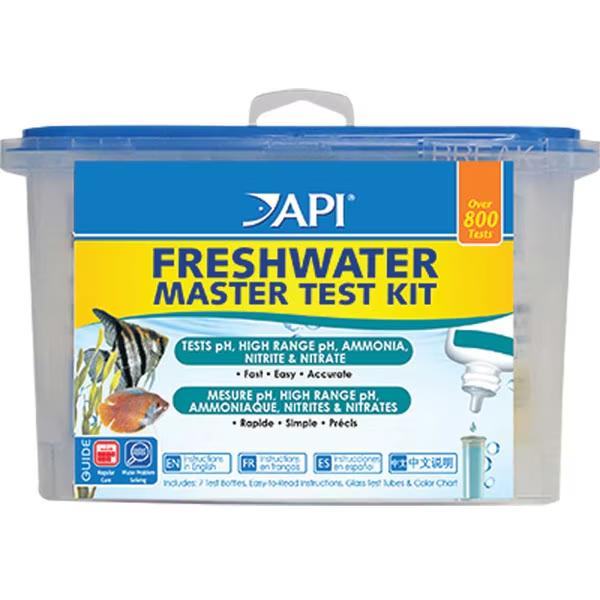
- Check expiration dates, storage, sample volume, timing, shaking, and color-reading directions for the exact kit.
- Record the unit and whether a result reports the whole compound or only its nitrogen component; those values are not interchangeable.
- Rinse sampling equipment as directed and avoid cross-contamination between reagents.
- Repeat an unexpected result and compare with a second method or qualified professional when the decision is high stakes.
- Test source water separately when it may contain ammonia, chloramine, nitrate, unusual hardness, or other relevant chemistry.
When livestock is already present
Detectable ammonia or nitrite with animals present is an urgent water-quality concern, not proof of a specific disease. Verify the result; check temperature, pH, oxygenation, flow, and equipment; reduce avoidable waste; and use appropriately conditioned water changes based on the animals and chemistry involved. Rapid correction can create risk when pH and ammonia chemistry are unusual, so severe or uncertain cases need qualified help.
Never use a generic calculator result instead of the current product label, actual water volume, species restrictions, or veterinary direction. Keep a timeline of test values, feeding, additions, mortalities, equipment failures, and water changes.
What the numbers do over a cycle
A fishless cycle has a recognizable shape. Ammonia rises first, from whatever controlled source you are dosing. After a lag, nitrite appears as the first group of microorganisms begins converting ammonia, and ammonia starts falling. Later, nitrate appears as a second group converts nitrite, and nitrite falls in turn. The system is demonstrating readiness when a repeated controlled input is processed to the point that ammonia and nitrite no longer remain measurable, with nitrate present as evidence that the conversion actually happened.
Reading that shape matters more than any single reading. Ammonia falling while nitrite climbs is progress, not a problem. Nitrate appearing is the confirmation that the second stage is working. A flat line where nothing changes for an extended period is the signal that something is limiting the process rather than that the process needs more time.
Record every result with its date. A cycle interpreted from memory is a cycle interpreted badly, and a written series makes it obvious whether the numbers are moving, stalled, or being pushed around by inconsistent testing.
Why a cycle stalls
Nitrifying microorganisms are living things with requirements, and a stalled cycle usually means one of those requirements is missing. They are aerobic, so poor circulation or low dissolved oxygen slows them. They consume alkalinity as they work, so a poorly buffered system can drift down in pH far enough to suppress them. They are temperature-sensitive, and a cold system works slowly. They need surface area, which is why removing or replacing media mid-cycle sets progress back.
Dosing too much ammonia is a common and counterintuitive cause. A very high concentration can inhibit the process rather than accelerate it, so a stalled cycle with a very high ammonia reading is often asking for dilution rather than patience. Chlorine or chloramine in untreated top-up water is another: it is added to kill microorganisms and does not distinguish yours from anything else.
Before concluding a cycle has stalled, verify the test itself. Expired reagents, an inaccurate sample volume, poor lighting when reading a colour chart, and cross-contaminated droppers all produce readings that describe the kit rather than the aquarium.
What bottled bacteria can and cannot do
Products that supply nitrifying microorganisms exist and can shorten establishment, but they are not a way to skip verification. Storage, shelf life, and handling affect whether a given bottle contains a viable population, and the aquarium still has to demonstrate through measurements that it processes its input. Follow the current label for the specific product, do not combine several products in the hope that one works, and do not use a product as a reason to stock earlier than the tests support.
Seeding from an established system — mature filter media, substrate, or rock from an aquarium you trust — transfers real capacity and is generally more reliable than a bottle. It also transfers whatever else that system carries, so it is a biosecurity decision as well as a biological one. The quarantine and biosecurity guide covers that trade-off.
Sources and further reading
Each source is listed with the part of this guide it supports. Source scope matters: a taxonomy record, product label, or general husbandry page does not automatically support every care claim.
- University of Florida IFAS: Ammonia in Aquatic Systems
Ammonia production, nitrification, biofilter requirements, testing, oxygen, alkalinity, and corrective context. - Merck Veterinary Manual: Management of Aquarium Fish
Fishless cycling, new-tank syndrome, water testing, and biofilter establishment. - University of Florida IFAS: Fish Health Management in Recirculating Systems
Water-quality parameters, source-water risks, nitrifying bacteria, and recirculating-system biofiltration.