


 Fishician®
Planted tank basics: substrate, lighting, and CO2
You can start a planted freshwater tank without injected CO2. Choose plants that suit your light, put them in the right place and adjust nutrients from how they grow.
The short answer
- Balance light, carbon and nutrients. More light raises plant demand for carbon and nutrients; increase it only when growth supports the change.
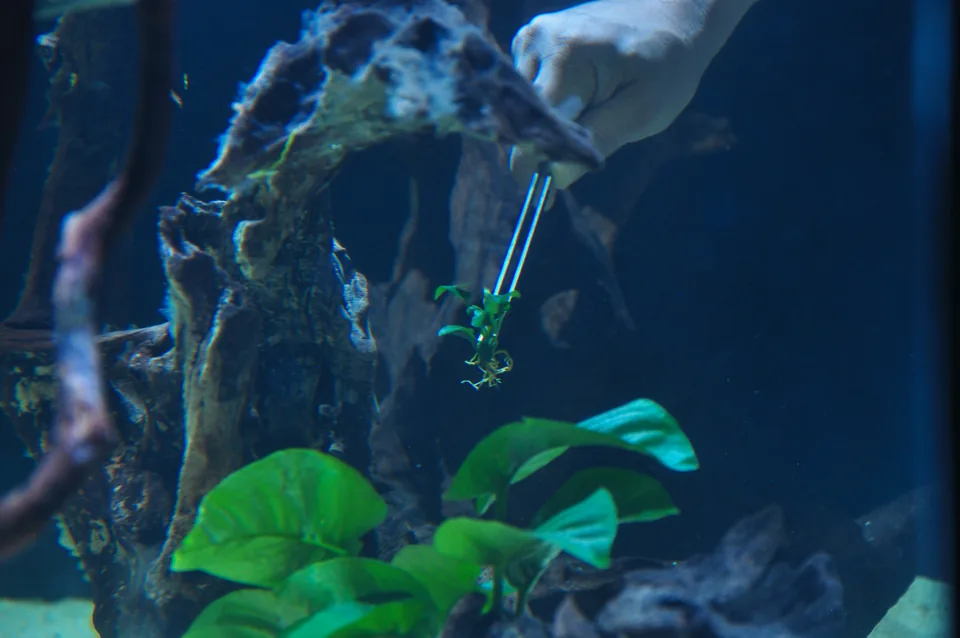
- Plant for the way it grows. Rooted plants go in substrate; Anubias and java fern can attach to wood or rock with their rhizomes exposed.
- Start with moderate light, not maximum output for a long day. Increase gradually.
- CO2 injection is optional. Low-tech and high-tech both work; they suit different plants and effort.
- If fish gasp, act immediately. With injected CO2, stop its delivery safely and increase aeration while checking the cause.

- Choose suitable easy plants
- Moderate light
- Match nutrients to growth
- A simpler starting point
- More equipment and monitoring
- Can support demanding plants
- Balance light and nutrients
- Protect gas exchange and fish
Choose plants, then place them
Check each plant's light, size and CO2 requirements before buying. Anubias, java fern and suitable Cryptocoryne varieties offer useful starting choices; a group name alone does not guarantee identical care.
- On wood or rock: attach Anubias and java fern without burying the rhizome, the horizontal stem from which leaves and roots grow.
- In the substrate: plant roots of rosette plants such as Cryptocoryne according to their planting instructions.
- Nutrients: rooted plants can use a suitable nutrient substrate or root tabs; attached plants need nutrients available in the water.
Follow the substrate's directions for rinsing or capping. These are product-specific, not a rule for every planted substrate. See substrate and hardscape.
Set a manageable light routine
Start with moderate light suited to the chosen plants and a consistent day/night cycle. Wattage measures power use, not the light reaching each leaf; tank depth and shading matter.
Do not raise brightness and extend the day together to chase faster growth. Watch new growth and algae, change one input at a time, and use the lighting guide to refine the routine.
Feed for the plants you have
Plants need carbon and mineral nutrients, including nitrogen, phosphorus, potassium and trace elements. What to add depends on plant demand, the substrate and nutrients already in the water.
Follow the fertilizer's starting dose and observe growth before adjusting. Poor growth has several causes; algae alone does not identify a deficiency. More light or more fertilizer is not automatically the next step.
If you add CO2
Suitable easy plants can grow using the CO2 already available in the tank. Injection expands your choices but adds equipment and monitoring.
- Follow the equipment's operating and night-control instructions. Maintain gas exchange; do not seal a gas-producing system to stop its flow.
- A drop checker responds slowly and cannot warn instantly of excess CO2. Watch the animals as well as the indicator.
- If fish gasp or deteriorate, stop CO2 delivery safely and increase aeration immediately. Check equipment and water quality; seek aquatic-veterinary help if distress is severe or persists.
What changes after lights-out?
In light, photosynthesis uses CO2 and produces oxygen. At night it stops, while respiration continues to use oxygen and release CO2. Injection and gas exchange also affect levels.
CO2 changes pH; it does not by itself consume total alkalinity. See water parameters.
Sources
Each source is listed with the part of this guide it supports.
- Tropica: Planting in the AquariumDifferent plant growth forms need different placement; Anubias and Microsorum rhizomes should not be buried and can be secured to wood or stone.
- Tropica: LightLight needs vary by plant; power consumption does not measure the light reaching leaves, and distance and position affect illumination.
- University of Florida IFAS: Dissolved Oxygen for Fish ProductionPhotosynthesis produces oxygen in light; respiration continues at night, when oxygen can decline.
- USGS: Alkalinity Calculator Frequently Asked QuestionsSection 3.1: CO2 entering or leaving water changes pH without itself changing total alkalinity.
- JBL: PRO AQUATEST CO2 Permanent plus pH InstructionsThe indicator takes time to respond; a drop checker is not an immediate alarm for excess CO2.
- Tropica: Fertiliser and CO2Plant requirements differ; light, nutrient supply and CO2 must be matched to the chosen plants.
- University of Florida IFAS: Dissolved Oxygen — Plant Management in Florida WatersAquatic-plant photosynthesis, carbon dioxide use, and the oxygen this process releases into the water.
- University of Florida IFAS: Ammonia in Aquatic SystemsHow pH and alkalinity interact with dissolved gases and nutrient chemistry in a closed aquatic system.
- Merck Veterinary Manual: Providing a Home for FishSubstrate, lighting, filtration, and general environmental setup considerations for an aquarium.