

 Fishician®
Aquarium filtration explained
A filter catches debris, provides a home for bacteria that process fish waste and may hold media for specific dissolved substances. Knowing those jobs helps you choose a filter and clean it without losing its biological support.
The short answer
- Biological filtration processes ammonia. Bacteria on oxygenated surfaces turn ammonia into nitrite, then nitrate. A new filter still needs to cycle.
- Trapped debris still needs removing. Mechanical filtration collects solids; cleaning takes them out of the system. A sponge can also carry useful bacteria.
- Chemical media has a specific purpose. Choose carbon or a resin for the substance it is designed to remove and follow its replacement instructions.
- Check how flow was rated. Media loading, hoses and lift affect flow. Biological capacity also depends on oxygen, temperature and waste load.
- Protect established biological media. Keep it wet; avoid untreated chlorinated water and replacing it all at once.
- Sponges, floss, pads
- Traps solid debris
- Remove the trapped waste
- Established sponge, ceramic media, rock
- Converts ammonia to nitrate
- Keep bacteria supported
- Carbon, targeted resins
- Removes specific substances
- Rule: use deliberately
Choose for the tank you will keep
Start with adult fish, feeding and the amount of waste the tank produces. A tank-size rating is a starting point, not proof that a filter can handle your stocking.
- Capacity: look for enough accessible biological media and a maintenance routine you can sustain.
- Flow: check how the maker measured it. Pump output and circulation through an installed filter can differ.
- Fish: provide circulation and surface movement without forcing animals into a current they cannot comfortably use.
The media needs time to establish. Follow the cycling guide and verify ammonia and nitrite, rather than treating a running pump as a cycled filter.
Clean it without starting over
Use the filter manual's service schedule, with earlier attention when debris builds up or flow falls.
- Shut down safely. Follow the model's unplugging, valve and draining sequence before opening it.
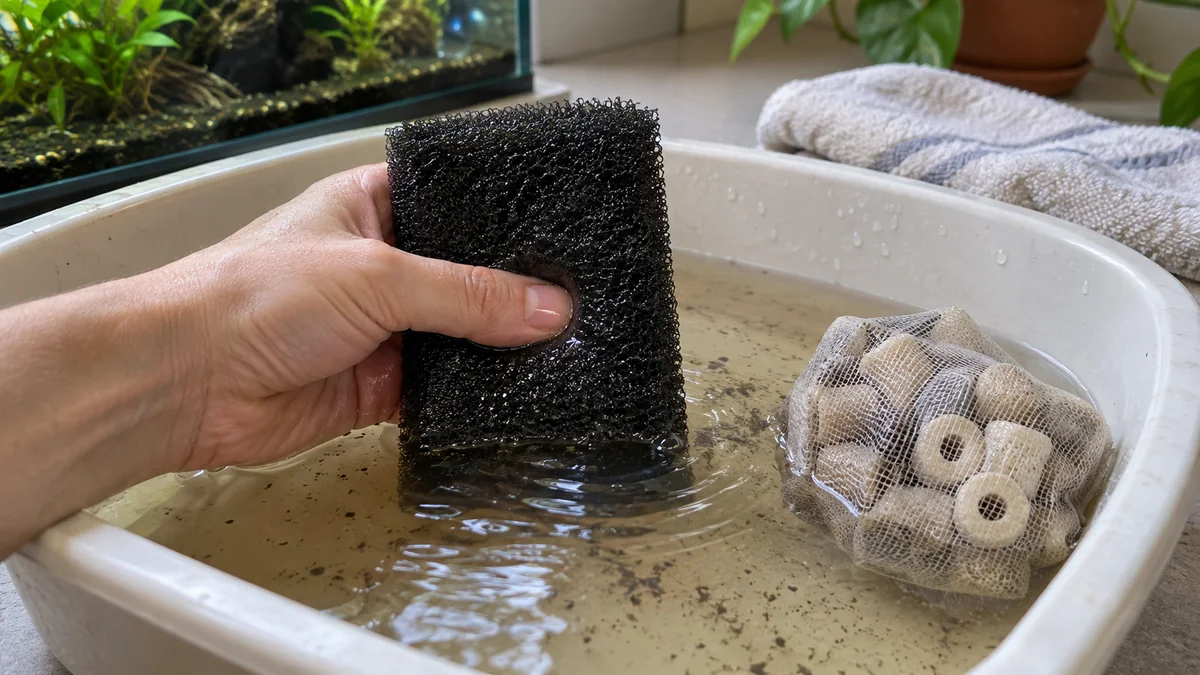
- Remove trapped debris. Clean reusable mechanical media as directed. Remember that a mature sponge also houses bacteria.
- Protect biological media. Gently rinse it in removed tank water when needed. Keep it wet and retain established media when replacing part of it.
- Inspect and restart. Check the intake, hoses, impeller and seals. Reassemble and prime as instructed, then confirm water flow and check for leaks.
Do not use soap or household cleaners. Keep equipment separate between tanks; shared wet media can also transfer pathogens.
When the filter stops
Support aeration while you check the fault. A filter without circulation loses its supply of oxygenated water; see the power-outage guide for immediate priorities.
After a prolonged shutdown, inspect and service a stagnant canister before returning its water to the tank. Check ammonia and nitrite after restart; restored flow alone does not prove that biological filtration has recovered.
A filter is part of the routine
Mechanical cleaning removes collected solids. Biological filtration transforms nitrogen waste; it does not make all dissolved waste disappear. Keep up water changes and testing even when the water looks clear.
Sources
Each source is listed with the part of this guide it supports.
- Fluval: FX4/FX6 Instruction ManualModel-specific shutdown, media cleaning, priming and seal checks; aquarium-water rinsing of biological media, partial media replacement and avoiding soap. Pump output and filter circulation are distinct ratings.
- Fluval: Bio-Foam+A sponge medium can provide both mechanical particle capture and surfaces for nitrifying bacteria, in freshwater and saltwater.
- University of Florida IFAS: Ammonia in Aquatic SystemsNitrification requires oxygen; biofilter capacity depends on feed input and establishment, and water testing is needed to check function.
- Merck Veterinary Manual: Providing a Home for FishFiltration purpose, filter capacity relative to the aquarium, beneficial bacteria, and equipment placement.
- University of Florida IFAS: Fish Health Management in Recirculating Systems, Part 1Recirculating-system water quality, oxygen demand and nitrifying biofiltration requirements.
- University of Florida IFAS: Fish Health Management in Recirculating Systems, Part 2System design, sanitation, disease-transfer risk between connected systems, and management practice.