

 Fishician®
Starting a freshwater aquarium
A simple freshwater setup can be a manageable first aquarium. Difficulty and cost depend on the species, equipment and source water.
The short answer
- Test your tap water first. City water usually needs a conditioner for chlorine or chloramine; well water can bring its own chemistry.
- Cycle before fish. Use a controlled ammonia source and prove it with tests, not a countdown.
- Plan for adults. Size, group needs and water overlap for every species before you buy any of them.
- Match water and space to the plan. Record your source-water measurements and the adult needs of the proposed species before buying.
- Add fish slowly. A small group first, more testing after, the next group only when readings hold steady.
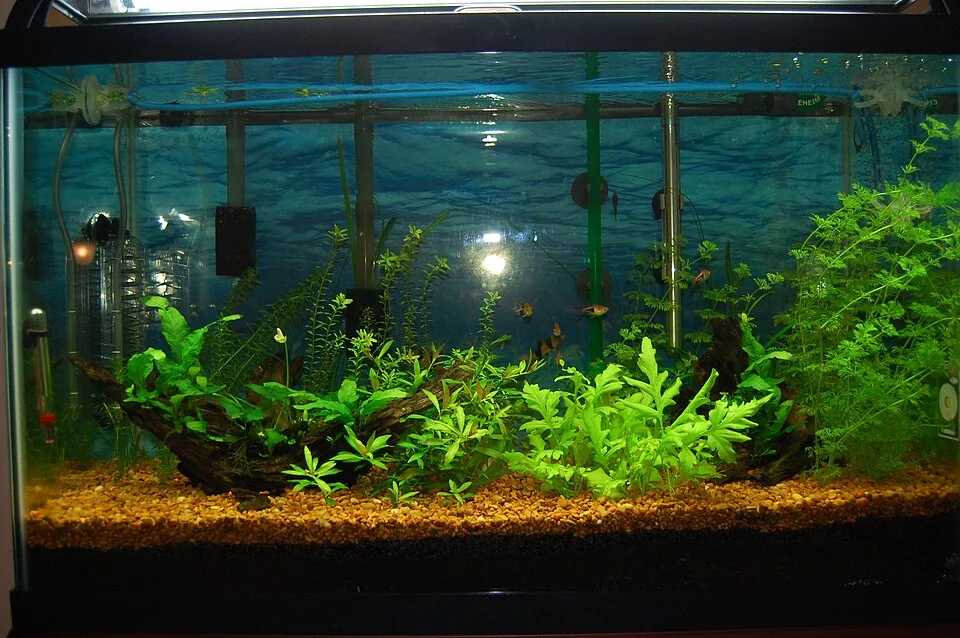

- Check tap waterConditioner rated for what's in it
- Set up and cycleControlled ammonia, regular tests
- First planned groupResearched social needs and load
- Test more oftenThe biofilter grows into the load
- Add the next groupOnly after readings hold steady
Create a freshwater source-water record
Before stocking, record the supply (municipal, well, or another source), its treatment, pH, temperature, and the hardness and alkalinity information needed by your proposed species. A water utility report helps identify supply treatment; it does not replace measurements of the water you will use.
For example, the API Freshwater Master Test Kit lists pH, high-range pH, ammonia, nitrite and nitrate. That list does not include GH or KH. If your plan requires those measurements, obtain suitable separate tests. This is a coverage example, not an endorsement or a universal kit requirement.
Copy this record: Supply ___; chlorine/chloramine information ___; preparation product and current directions ___; pH ___; temperature ___; GH with units ___; alkalinity/KH with units ___; date ___; species questions still unresolved ___. Do not add chemicals merely to make a number match an internet target.
Read the startup log rather than the calendar
Hypothetical fishless-cycle observations: these examples show decisions, not a dosing protocol or a predicted timeline. Use the controlled ammonia source's directions and the cycling guide. Record the kit, units, sampling time and any addition.
- Ammonia declines, but nitrite remains detectable
- Part of the conversion is occurring; the tank is not ready for fish. Continue the fishless protocol and testing. Do not treat falling ammonia alone as completion.
- Both read zero, but no ammonia input was documented
- The readings alone do not demonstrate processing capacity. Check the log and protocol rather than assuming an empty, clean tank has a working biofilter.
- The documented protocol is completed and ammonia and nitrite are undetectable
- Review temperature, prepared water and the planned initial stocking before proceeding. Test after additions; a result at one load does not prove capacity for the full eventual population.
- Readings stop progressing
- Check the method, filter operation, aeration, temperature and alkalinity context. Avoid repeatedly adding more ammonia or unrelated products without identifying the issue.
Nitrate appearing can support the picture, but nitrate alone does not prove that ammonia and nitrite are being handled. Keep the measurements together.
A log you can copy for the first arrivals
Use one line per observation: Date/time ___; animal count and identity ___; ammonia value, units and kit ___; nitrite ___; nitrate ___; pH ___; temperature ___; feeding and leftovers ___; breathing and activity ___; changes made ___; next check ___.
Example decision: after an addition, ammonia or nitrite becomes detectable. Stop further stocking and promptly investigate water preparation, filter function, feeding and the test result. With fish present, this is a care problem, not a reason to keep waiting for the cycle. Consult safe water-change preparation; urgent distress requires aeration support, equipment checks and qualified aquatic-veterinary help without waiting for a perfect log.
If readings hold but a fish cannot get food or stays cornered, investigate social and space problems. Water tests do not establish compatibility. Keep an appropriate separation option available.
Sources
Each source is listed with the part of this guide it supports.
- API: Freshwater Master Test KitProduct-specific test coverage (pH, high-range pH, ammonia, nitrite and nitrate); individual booklet directions govern the procedure. GH and KH are not in the listed coverage.
- University of Florida IFAS: Ammonia in Aquatic SystemsAmmonia and nitrite conversion, source-water ammonia, and oxygen and alkalinity needs of nitrifying biofilters. No universal startup timetable or ammonia dose is adopted.
- University of Florida IFAS: Responsible Aquarium Fish OwnershipPre-purchase research, source-water evaluation, and planning for a new aquarium's long-term needs.
- Merck Veterinary Manual: Providing a Home for FishEquipment, water preparation, and environmental setup for a new freshwater aquarium.
- Merck Veterinary Manual: Management of Aquarium FishCycling, gradual stocking, and common early-setup failure points.