

 Fishician®
Troubleshooting
Cloudy water: causes and fixes
Cloudy water has several causes with different fixes. Match the cause before reaching for a clarifier.
The short answer
- Look at the colour. Colour and timing suggest causes, but cannot identify them on their own.
- White in a new tank may be a bacterial bloom or suspended dust. Check water quality, aeration and fish before deciding to wait.
- Haze after cleaning is usually fine particles. Fine mechanical filtration clears it.
- Green water can be floating algae. Review light, feeding and water tests. Keep light and nutrients suitable for plants or photosynthetic corals.
- Brown is usually tannins. Mostly cosmetic. Activated carbon clears it if you prefer.
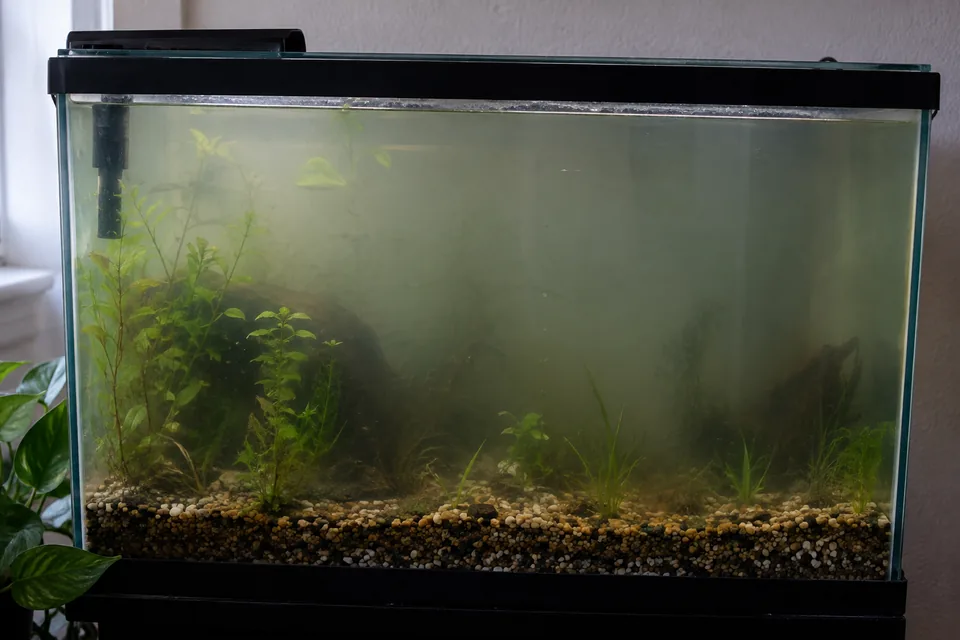
Match the colour to the cause
White / grey
- Bacterial bloom or fine dust
- Common in new or disturbed tanks
- Test ammonia and nitrite
Green
- May be free-floating algae
- Review light and nutrient inputs
- Protect plant and coral needs
Brown / yellow
- Tannins from wood or leaves
- Usually harmless
- Carbon if you want it clear
White haze: bacterial bloom
- Appears within a day or two of setup or a big substrate disturbance.
- A bloom can increase oxygen demand. Ammonia or nitrite may indicate an immature or disturbed biofilter; test rather than judging by appearance. See cycling.
- Do not add extra food or stack products. If fish are distressed or tests show a problem, act promptly; suitable water changes may be needed.
Fine particles
- Substrate dust or disturbed decor settles slowly and tends to persist.
- A fine filter pad clears it faster than waiting.
- Rinse new substrate well and go easy on the gravel vacuum after rescaping.
Green water
- Floating algae, not the kind on the glass. Scraping won't touch it.
- Review the lighting schedule, direct sunlight, feeding and stocking. Correct excesses while meeting the needs of your animals and plants.
- Reef tanks: photosynthetic corals need appropriate light and nutrients too. Do not apply a blanket blackout or drive nitrate and phosphate to zero to clear green water. Identify the problem and adjust for the corals you keep.
- UV or fine filtration removes it faster, but fix the inputs or it returns. See algae control.
What not to do
- Stack clarifiers, or mix one with another treatment without reading both labels.
- Do a huge emergency water change on a new or crowded tank for cloudiness alone.
- Assume it's the same cause as last time.
Timing tells you a lot
- Sudden haze within a day or two of setup: usually a bacterial bloom.
- Haze after rescaping or vacuuming may be particles; persistent haze or distressed fish needs investigation.
- Green building up over days: light and nutrients.
- Brown after adding wood or leaves: tannins.
- Note what changed recently before choosing a fix.
Sources
Each source is listed with the part of this guide it supports.
- Red Sea: Light Intensity and PhotoperiodLight intensity and duration affect coral health; photosynthetic corals require appropriate illumination and a dark period.
- Red Sea: Reef Care ProgramCoral symbionts use nitrate and phosphate; managing nuisance growth should not indiscriminately eliminate the nutrients needed by corals.
- Merck Veterinary Manual: Management of Aquarium FishNew-tank syndrome, bacterial establishment, and water-quality problems that present as visible changes in the water.
- University of Florida IFAS: Ammonia in Aquatic SystemsHow nutrient and ammonia loading drive bacterial and algal population changes in a closed system.
- Merck Veterinary Manual: Essential MaintenanceRoutine mechanical filtration and cleaning tasks relevant to suspended particulate.