

 Fishician®
Saltwater fundamentals
Reef tank basics: live rock, salinity, and protein skimming
Three things set a reef apart: what seeds the biofilter, how precisely you measure the water, and how waste leaves before it becomes nitrate.
The short answer
- Live rock is scenery and filter. It carries much of the biological filtration.
- Uncured rock needs its own cycle. Its die-off causes an ammonia and nitrite spike. No fish until tests clear.
- Measure salinity with calibrated tools. Clean and verify the instrument as its manufacturer directs; bubbles, residue and calibration errors can affect readings.
- A skimmer exports waste as foam before it becomes nitrate. It supplements water changes; it doesn't replace them.
- Stability earns the next step. Additions should depend on stable conditions and the needs of the species.
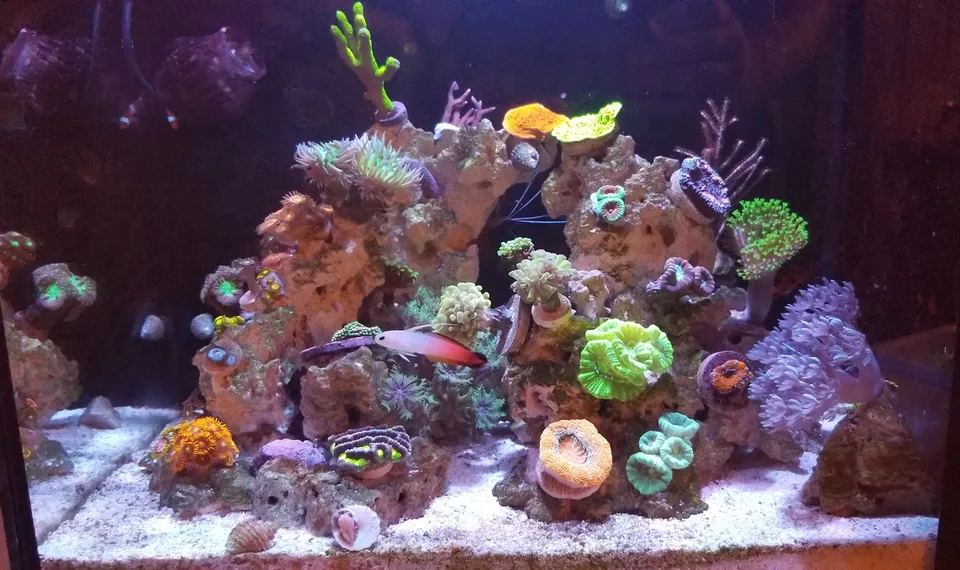

Build a reef in this order
- Cycle and verifyLive rock and/or controlled ammonia
- StabilizeSalinity, temperature and flow
- Hardy livestockQuarantined first
- Sensitive speciesOnly after a long stable stretch
Live rock
- Cured rock has finished its die-off; uncured carries more life and more decaying material.
- With uncured rock, treat the start like a fishless cycle: test, run circulation and the skimmer. See cycling.
- Rinse rock in mixed saltwater, not tap water, before placing it.
Salinity
- Follow the salt-mix instructions for mixing and temperature before measuring; undissolved salt can give an unrepresentative sample.
- Match temperature and salinity before any water goes into the display. See water changes.
- Top off evaporation with fresh water; more saltwater raises salinity.
Protein skimmer
- Air bubbles collect dissolved organics and lift them out as foam into a cup.
- Expect a break-in of days to weeks with thin or patchy foam.
- Empty and rinse the cup regularly so it doesn't overflow or clog.
- Size it to the real waste load, not the tank's label volume.
Lighting
- Many corals and anemones host photosynthetic symbionts; others do not. Lighting and feeding must match the species.
- Fish-only with live rock has far more lighting latitude than a coral reef.
- Research each coral's needs; one setting doesn't suit everything. See lighting.
Measuring tools and quarantine
- Calibrate according to the exact instrument’s instructions. Some refractometers require distilled or deionized water; others use a specified standard.
- Keep hydrometers clean, remove trapped bubbles and follow their temperature instructions. Compare suspect readings with a verified instrument.
- Check the instrument before acting on a surprising salinity reading.
- Many marine treatments kill invertebrates, so quarantine new fish before they enter a reef.
Sources
Each source is listed with the part of this guide it supports.
- Hanna Instruments: HI96822 Seawater RefractometerA model-specific example requiring distilled or deionized water for zero calibration; calibration instructions cannot be generalized across instruments.
- Merck Veterinary Manual: Providing a Home for FishAquarium environment, filtration purpose, and water-preparation fundamentals that apply to marine systems.
- Merck Veterinary Manual: Management of Aquarium FishWater-quality monitoring, biofiltration, and management practices relevant to marine as well as freshwater systems.
- University of Florida IFAS: Dissolved Oxygen for Fish ProductionHow temperature and salinity affect dissolved-oxygen solubility, relevant to aeration and gas exchange in marine systems.